You create a task in Planner, a colleague has a question about it, the two of you sort it out in a Teams chat. Two weeks later someone asks why the task was done that way, and nobody remembers where that answer went. The Teams channel has long moved on, the email thread is lost, the note sits in a notebook nobody opens any more.
Anyone who juggles several projects at once knows this context problem. And that is exactly why Microsoft introduced task chat in Planner in early 2026. You discuss tasks right where they live: in the task itself. No channel searching, no reconstructing context, no «who decided that again?»
In this post I show you how to get task chat going in five steps and how to use it so your team really benefits.
What is task chat and who has access?
Task chat is a conversation area that sits directly inside every Planner task. You can write messages, pull team members in with an @mention, react to messages and link attachments from OneDrive or SharePoint.
The most important point first: task chat has been available since early 2026 for all Microsoft 365 Business plans, you do not need a Planner Premium licence. It was part of the big Planner update that Microsoft started rolling out in mid January 2026. If you use Planner in Teams or at planner.cloud.microsoft, you already have the feature.
Step 1: Open task chat inside a task
Here is how you get to task chat: 🚀
- Open Microsoft Planner in Teams (app bar on the left, search for «Planner») or go straight to planner.cloud.microsoft.
- Pick a plan and click any task. The details panel opens.
- Task chat appears right away on the right-hand side of the panel, next to the task details.
- Click into the task chat input field to write your first message.
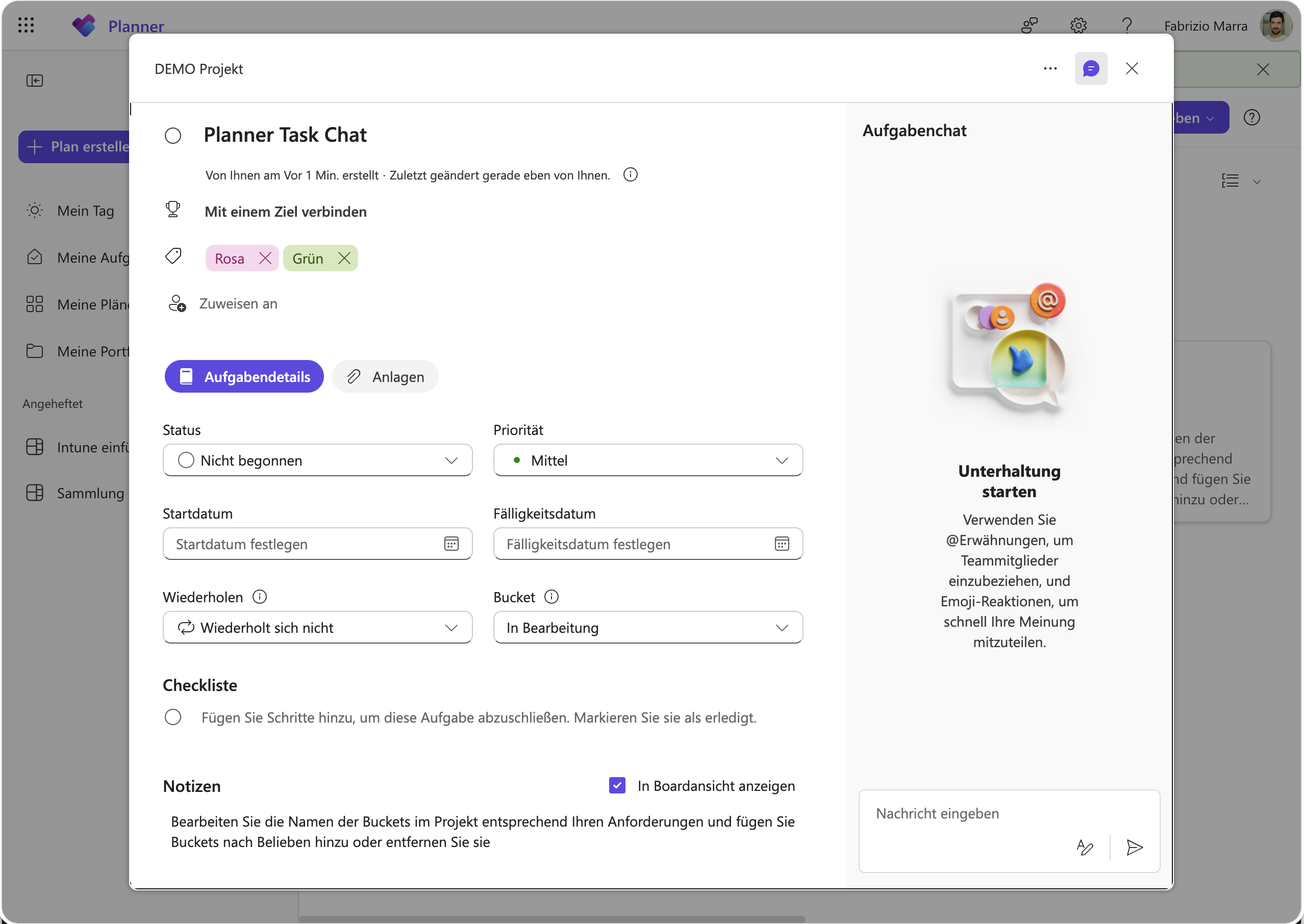
If you cannot see task chat yet, check the Planner app version in Teams under Settings, About. The update rolled out in waves from mid January 2026 and should be active everywhere by now.
Step 2: Write your first message and capture context
Task chat works like the familiar Teams chat, but it is permanently tied to the task. All messages stay visible for as long as the task exists. 💬
- Click into the input field below «Conversation».
- Write your message, for example: «Template is ready, please review by Friday.»
- Send it with Enter or the send icon.
The message appears in the task's chat history. Every plan member sees the entry, not only the people the task is assigned to. That matters when you want the whole team to stay informed.
What I value most: the history stays complete. Anyone who comes to the task two weeks later reads everything, questions, decisions, corrections, in one single, ordered view.
Step 3: Bring in specific team members
For concrete questions to a particular person you use the @mention. It works exactly as it does in Teams or Outlook. 👋
- In the comment field type @ followed by the person's name.
- A list of plan members appears. Select the person you want.
- Write your question and send the message.
The mentioned person gets a notification in Teams and by email. One click on the notification takes them straight to the task in question, no channel hunting, no scrolling.
Tip: use @mentions deliberately. A general comment without a mention informs the team quietly. An @mention signals: «I need a specific response from you.» That stops important questions from disappearing into the noise.
Step 4: Use rich text, reactions and attachments
Task chat can do more than plain text. You can structure messages and react to them, much like in Teams channels.
Formatting options: 📝
- Bold with Ctrl+B, italic with Ctrl+I
- Bulleted lists for structured feedback
- Code blocks for technical content or error messages
You react to messages with emoji, a thumbs up, a heart, a «yes» emoji is often enough as confirmation. That keeps the chat clean and saves short «OK, thanks» messages.
You add attachments through the paperclip icon in the input field. Files from OneDrive and SharePoint you link directly. The attachment then sits neatly in the conversation history, and not somewhere in an email thread nobody can find any more.
Step 5: Configure notifications sensibly
By default you get notified when somebody writes in a task that is assigned to you or that you have commented on yourself. That is good, but it can get noisy fast on active projects.
Here is how you adjust notifications: ⚙️
- Open Planner and click Settings in the top right.
- Choose Notifications.
- Turn the email notifications you want on or off, for example when somebody assigns you a task or when a task becomes due.
My recommendation: turn on notifications for task assignments, but switch off the general due-date pings if you work across five or more active plans. That way you stay informed without being interrupted constantly.
Practical tip: task chat as a decision log
My personal favourite use case: use task chat as a decision log. Instead of settling things verbally or scattering them across Teams messages, write the decision straight into the task as a comment, for example: «14 June 2026: team decided to move the deadline to Friday because customer feedback is still outstanding.» Anyone opening the task three weeks later understands why immediately, without having to search anywhere.
That sounds simple, but it changes the work noticeably: fewer «who decided that?» moments, fewer meeting minutes nobody reads and less lost information when somebody on the team moves on.
Conclusion
Task chat in Microsoft Planner solves a problem many teams had accepted as unavoidable: lost context. When the discussion hangs off the task itself, the channel searching stops. Decisions are traceable, questions are answered and visible, and new team members find their way without a lengthy briefing. Turn to task chat on your next Planner task, and write the first comment there instead of in Teams. Give it a go right now.